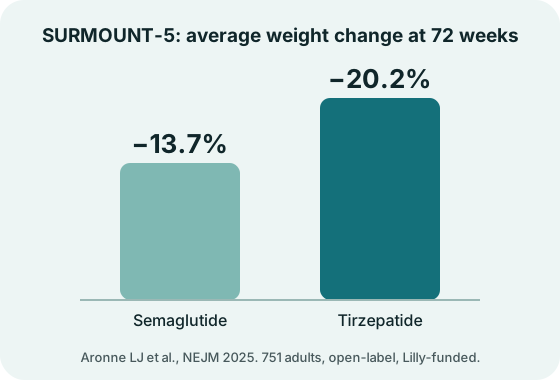
Semaglutide vs tirzepatide comes down to mechanism and size of effect. Semaglutide (Wegovy, Ozempic) acts on one hormone receptor, GLP-1. Tirzepatide (Zepbound, Mounjaro) acts on two, GIP and GLP-1. In SURMOUNT-5, the only head-to-head trial in obesity, tirzepatide led to 20.2% average weight loss at 72 weeks versus 13.7% with semaglutide. Side effects are similar and mostly digestive.
This article is general information, not medical advice. The right medication depends on your health, insurance and goals. Talk to your prescriber, and follow the Medication Guide that came with your medication.
Key takeaways
- Semaglutide is a GLP-1 receptor agonist; tirzepatide is a dual GIP and GLP-1 receptor agonist.
- In SURMOUNT-5 (751 adults, 72 weeks), tirzepatide averaged −20.2% body weight vs −13.7% for semaglutide.
- The most common side effects for both are nausea, diarrhea, vomiting and constipation, mostly during dose increases.
- Both carry the same boxed warning about thyroid C-cell tumors seen in rodents.
- Approved uses differ: Wegovy also covers heart-risk reduction and MASH; Zepbound also covers obstructive sleep apnea.
In this guide
Semaglutide vs tirzepatide at a glance
Both are once-weekly injections approved by the FDA for chronic weight management, and both come in a diabetes version. The table summarizes the official prescribing information and the SURMOUNT-5 trial.
| Semaglutide | Tirzepatide | |
|---|---|---|
| Brands | Wegovy (weight), Ozempic (diabetes), Rybelsus (diabetes pill), Wegovy tablets | Zepbound (weight), Mounjaro (diabetes) |
| How it works | GLP-1 receptor agonist | GIP and GLP-1 receptor agonist |
| Weight loss in SURMOUNT-5 | −13.7% at 72 weeks | −20.2% at 72 weeks |
| Nausea in placebo-controlled trials | 44% (Wegovy 2.4 mg) vs 16% placebo | 25–29% (Zepbound) vs 8% placebo |
| Weekly maintenance dose (weight) | 2.4 mg or 1.7 mg; 7.2 mg in some cases | 5, 10 or 15 mg |
| Pill option for weight | Yes, Wegovy tablets (approved December 2025) | No |
| Other approved uses | Heart-risk reduction (Wegovy), MASH (Wegovy), kidney outcomes in diabetes (Ozempic) | Obstructive sleep apnea (Zepbound), heart-risk reduction in diabetes (Mounjaro) |
Nausea rates come from different trials pooled in each label, so they aren’t a direct comparison. The head-to-head results below are a fairer test.
How do semaglutide and tirzepatide work?
Both mimic gut hormones released after you eat, which slow stomach emptying and reduce appetite. The Wegovy label describes semaglutide as “a glucagon-like peptide-1 (GLP-1) receptor agonist.” The Zepbound label describes tirzepatide as a “glucose-dependent insulinotropic polypeptide (GIP) receptor and glucagon-like peptide-1 (GLP-1) receptor agonist.”
That second hormone target, GIP, is the main pharmacological difference. Researchers are still studying exactly how much it adds, but the head-to-head trial suggests the combination produces more weight loss on average.
Which causes more weight loss: semaglutide or tirzepatide?
Tirzepatide caused more weight loss in the only direct comparison. In SURMOUNT-5, published in the New England Journal of Medicine in 2025, 751 adults with obesity and without type 2 diabetes took the highest dose they tolerated of either drug for 72 weeks.
| SURMOUNT-5 result at 72 weeks | Semaglutide (1.7 or 2.4 mg) | Tirzepatide (10 or 15 mg) |
|---|---|---|
| Average weight change | −13.7% | −20.2% |
| Average waist change | −13.0 cm | −18.4 cm |
| Stopped because of digestive side effects | 5.6% | 2.7% |
Two caveats matter. The trial was open-label, so participants knew which drug they were taking, and it was funded by Eli Lilly, which makes tirzepatide. Results are averages: some people lose more on semaglutide than others do on tirzepatide. Waist and discontinuation figures are from the American College of Cardiology’s SURMOUNT-5 journal scan.
Which has fewer side effects?
The side-effect profiles are similar. Both labels list nausea, diarrhea, vomiting, constipation and stomach pain as the most common, and the SURMOUNT-5 authors reported that most were “mild to moderate in severity and occurred primarily during dose escalation.”
| Side effect | Wegovy 2.4 mg | Zepbound 5 / 10 / 15 mg | Placebo (W / Z) |
|---|---|---|---|
| Nausea | 44% | 25 / 29 / 28% | 16% / 8% |
| Diarrhea | 30% | 19 / 21 / 23% | 16% / 8% |
| Vomiting | 24% | 8 / 11 / 13% | 6% / 2% |
| Constipation | 24% | 17 / 14 / 11% | 11% / 5% |
| Stopped due to side effects | 6.8% | 4.8 / 6.3 / 6.7% | 3.2% / 3.4% |
These come from separate pooled placebo-controlled trials in each label, with different populations, so compare each drug with its own placebo column rather than with each other.
Warnings both share
Both labels carry a boxed warning that the drug caused thyroid C-cell tumors in rodents and that it’s unknown whether it does so in humans. Neither should be used by people with a personal or family history of medullary thyroid carcinoma or with Multiple Endocrine Neoplasia syndrome type 2 (MEN 2).
What is each one approved for?
Beyond weight management, the approvals differ, which can affect insurance coverage. The FDA approved Zepbound for weight management in November 2023 and later as the first medication for obstructive sleep apnea in adults with obesity. Wegovy was approved to reduce the risk of serious heart problems in March 2024.
- Wegovy (semaglutide): weight management (adults and ages 12+), cardiovascular risk reduction in adults with heart disease and obesity or overweight, and noncirrhotic MASH with moderate to advanced fibrosis (accelerated approval, 2025).
- Wegovy tablets: once-daily oral semaglutide for adult weight management and cardiovascular risk reduction.
- Ozempic: type 2 diabetes, including cardiovascular and kidney outcomes.
- Zepbound (tirzepatide): weight management and moderate to severe obstructive sleep apnea in adults with obesity.
- Mounjaro: type 2 diabetes (adults and children 10+), with a cardiovascular risk-reduction indication added in 2026.
How are semaglutide and tirzepatide dosed?
Both start low and step up every 4 weeks to limit stomach side effects. This overview comes from the labels; your prescriber sets your actual schedule.
| Medication | Starting dose | Steps | Maintenance |
|---|---|---|---|
| Wegovy injection (weekly) | 0.25 mg for 4 weeks | 0.5 → 1 → 1.7 mg, every 4 weeks | 2.4 mg (or 1.7 mg); 7.2 mg only if 2.4 mg is tolerated and more loss is needed |
| Wegovy tablets (daily) | 1.5 mg for 30 days | 4 mg, then 9 mg, every 30 days | 25 mg |
| Zepbound (weekly) | 2.5 mg for 4 weeks | +2.5 mg at least every 4 weeks | 5, 10 or 15 mg (10 or 15 mg for sleep apnea) |
A dose log helps here. Wanewell (our app, coming soon) keeps a timeline of each dose step next to your weight and side effects, so you and your prescriber can see how each increase went. It never suggests a dose; you enter what you were prescribed.
What about compounded semaglutide and tirzepatide?
Compounded versions were widely sold during the drug shortages, which have now ended. The FDA declared the tirzepatide shortage resolved on December 19, 2024 and the semaglutide shortage resolved on February 21, 2025, and the grace periods for compounders have since ended, according to the FDA’s compounding statement, updated April 2026.
The FDA stresses that “compounded drugs are not approved by FDA,” meaning they haven’t been reviewed for safety, effectiveness or quality. If you use a compounded product, ask your prescriber and pharmacy exactly what’s in it and how to measure your dose.
How to decide with your doctor
The best choice depends on more than average weight loss. These questions help structure the conversation with your prescriber:
- What does my insurance cover? Coverage often depends on the approved indication, such as heart disease or sleep apnea.
- Do I have conditions one drug is approved for? For example, established heart disease (Wegovy) or obstructive sleep apnea (Zepbound).
- Would I prefer a daily pill? Only semaglutide has an approved oral version for weight management.
- What’s the self-pay price? Both makers run cash-pay programs. Novo Nordisk lists self-pay Wegovy prices on NovoCare; check LillyDirect for Zepbound.
- How did I tolerate my current medication? Switching is possible, but your prescriber will decide the starting dose.
Where this comparison falls short. We can only compare what’s published. Trials report averages, labels pool different studies, and prices change often. Your own response to either medication can differ from these numbers.
Frequently asked questions
Is Zepbound stronger than Wegovy?
On average, yes, for weight loss. In the SURMOUNT-5 head-to-head trial, people on tirzepatide (the drug in Zepbound) lost 20.2% of body weight at 72 weeks versus 13.7% on semaglutide (the drug in Wegovy). Individual results vary, and the trial was open-label and funded by Lilly.
Can you switch from semaglutide to tirzepatide?
People do switch, but there’s no label-defined conversion between the two drugs. Your prescriber decides when to stop one and what dose to start the other, usually based on your current dose and how well you tolerated it. Don’t switch on your own.
Which has fewer side effects, semaglutide or tirzepatide?
They’re broadly similar: mostly nausea, diarrhea, vomiting and constipation, especially during dose increases. In SURMOUNT-5, fewer people stopped tirzepatide for digestive side effects (2.7%) than semaglutide (5.6%), but individual tolerance varies.
Is there a pill version of Wegovy or Zepbound?
Yes for Wegovy: once-daily Wegovy tablets (oral semaglutide) were approved for weight management in December 2025. There is no approved oral version of tirzepatide.
Are Ozempic and Wegovy the same drug?
Both contain semaglutide, but they’re approved for different uses with different doses. Ozempic is approved for type 2 diabetes, and Wegovy for weight management and heart-risk reduction. The same applies to Mounjaro and Zepbound, which both contain tirzepatide.
Sources
- Aronne LJ, et al. Tirzepatide as Compared with Semaglutide for the Treatment of Obesity (SURMOUNT-5). New England Journal of Medicine. 2025;393(1):26–36.
- American College of Cardiology, Journal Scan: SURMOUNT-5, July 2025.
- Novo Nordisk, Wegovy injection and tablets Prescribing Information, revised 05/2026 (FDA).
- Eli Lilly, Zepbound Prescribing Information, revised 02/2026 (FDA).
- Eli Lilly, Mounjaro Prescribing Information, revised 08/2026 (FDA).
- Novo Nordisk, Ozempic Prescribing Information, revised 05/2026 (FDA).
- FDA, FDA Approves New Medication for Chronic Weight Management, November 8, 2023.
- FDA, FDA Approves First Medication for Obstructive Sleep Apnea, 2024.
- FDA, FDA Approves First Treatment to Reduce Risk of Serious Heart Problems Specifically in Adults with Obesity or Overweight, March 8, 2024.
- FDA, FDA clarifies policies for compounders as national GLP-1 supply begins to stabilize, updated April 1, 2026.
- Novo Nordisk, Wegovy pill FDA approval, December 22, 2025.
The Wanewell team builds Wanewell, a GLP-1 shot tracker. We write our guides from the official prescribing information and peer-reviewed research, and link every source so you can check it. We have no relationship with Novo Nordisk or Eli Lilly. Spotted an error? Tell us.